
Croscar
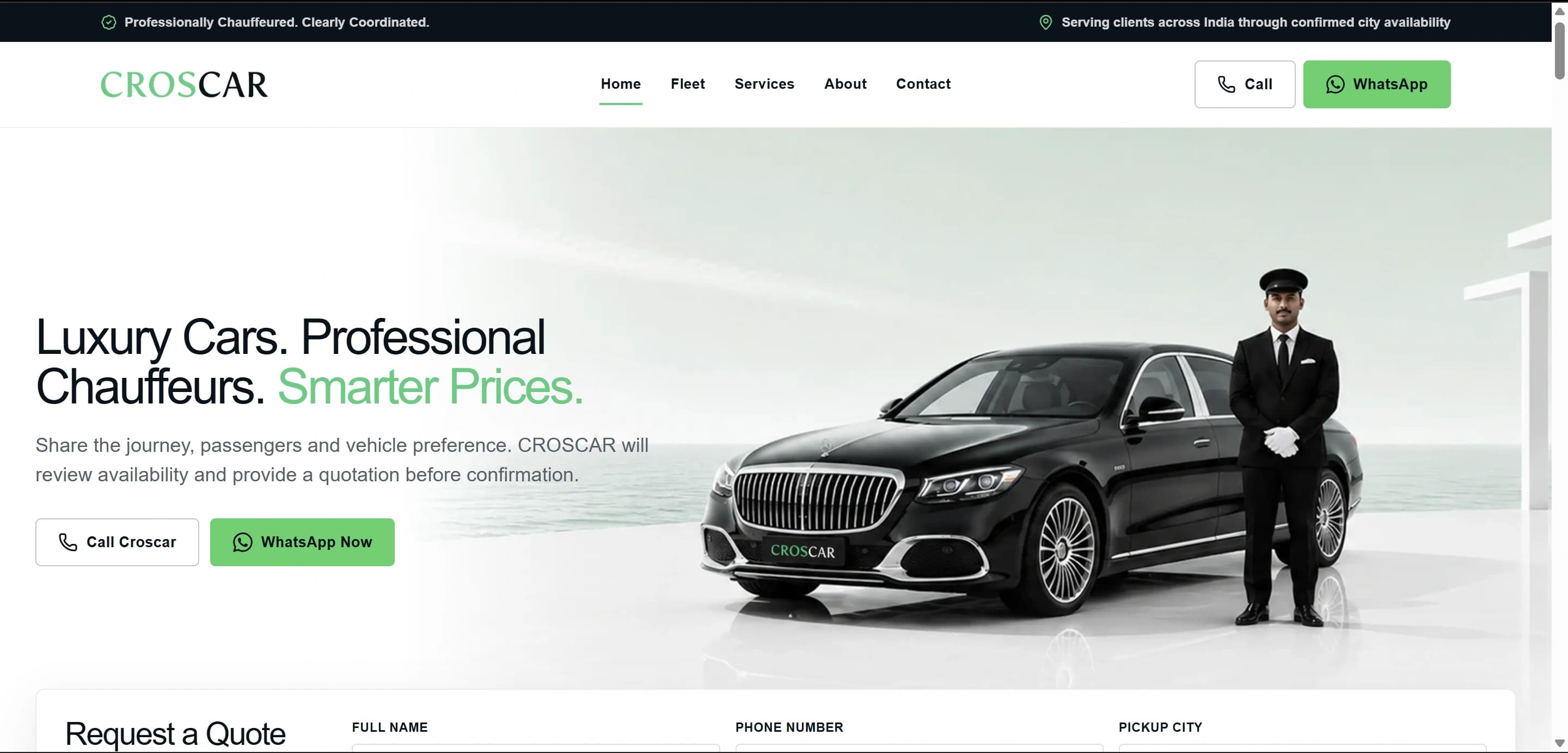
A public-facing mobility and car-rental website built to launch the brand, present its fleet and services, and connect potential customers through enquiry and quotation journeys.
- Sole Full-Stack Developer & Technical Owner
- Public product and service website
- URV India Pvt. Ltd.
- Company product · sole developer responsible for technical implementation · collaboration with business and design stakeholders
- Next.js
- Tailwind CSS
The project in operational terms.
Scope, complexity, responsibility, and business outcomes are described without unsupported statistics.
What was built?
A responsive Next.js and Tailwind CSS website with reusable fleet, service, supporting-page, SEO, navigation, and enquiry structures.
Who uses it?
Prospective customers exploring vehicles, transfer and rental services, and direct quotation or enquiry options.
Why does it matter?
A new mobility brand needs clear information architecture, responsive fleet and service presentation, and direct contact journeys rather than a large internal software platform.
What did Amit own?
Amit planned and delivered the website, defined its technical structure, implemented reusable components, translated approved design requirements, and prepared the product for launch.
What changed?
Croscar gained a maintainable digital presence for brand discovery, fleet exploration, service evaluation, and direct customer enquiries.
Understand the operation before the technology.
Croscar required a focused public product and service website rather than a broad operations platform.
The delivery work centred on clear fleet and service information, responsive navigation, search-friendly page structure, technical SEO, and direct call, WhatsApp, and quote-request journeys.
Product capabilities.
Capabilities describe the product; Amit's contribution is documented separately below.
Fleet and service presentation
Reusable structures explain available mobility services.
- Fleet presentation
- Airport-transfer content
- Local and hourly rental
- Outstation and corporate travel
- About and supporting pages
Enquiry journey
Visitors can move from evaluation to direct contact.
- Call enquiries
- WhatsApp journeys
- Quote-request workflow
- Responsive navigation
Search and delivery foundations
The site is structured for maintainable public discovery.
- Search-friendly page hierarchy
- Technical SEO foundations
- Reusable Next.js components
- Responsive Tailwind CSS implementation
Amit's contribution and responsibilities.
Architecture, implementation, technical ownership, delivery coordination, production responsibility, and stakeholder collaboration are described separately to make individual contribution explicit.
01
Architecture
Defined the route, component, fleet, service, content, SEO, and enquiry structure for a focused public website.
02
Implementation
Built the product using Next.js and Tailwind CSS with reusable components and service-page structures.
03
Technical ownership
Defined the technical implementation and translated approved brand, content, fleet, service, SEO, and design requirements into the production website.
04
Delivery coordination
Aligned content, fleet, services, responsive behavior, SEO, enquiry, and launch requirements.
05
Production ownership
Prepared the website for launch and maintainable delivery on the Croscar domain.
06
Stakeholder collaboration
Translated brand and service requirements into a public information and enquiry experience.
The boundaries that shaped the work.
These are product and delivery constraints, not a disclosure of private production configuration.
Focused product scope
The case study describes a public website and does not imply unverified companion applications.
Responsive service discovery
Fleet, service, and enquiry content must remain clear on mobile and desktop.
Direct contact handoff
Call, WhatsApp, and quote actions need clear context without exposing customer data.
Search consistency
Routes, headings, metadata, and service content need one coherent public story.
Public discovery-to-enquiry website architecture
A static, keyboard-inspectable model with visible relationships and a complete text alternative.
Croscar public website architecture
Reusable content structures lead visitors from discovery to direct enquiry.
Discovery
Public routes and search entry points.
- Homepage & brand
Core positioning and featured paths.
- Fleet presentation
Vehicle exploration.
- Service pages
Transfer, rental, outstation, and corporate travel.
Page system
Reusable responsive delivery.
- Next.js routes
Search-friendly public page structure.
- Reusable components
Consistent fleet, service, content, and enquiry sections.
- Technical SEO
Metadata and semantic page foundations.
Enquiry
Direct customer contact journeys.
- Call
Direct phone enquiry action.
- WhatsApp
Messaging enquiry journey.
- Quote request
Structured request for service context.
Relationships
- Fleet presentationEnquirysupports vehicle evaluation and contact
- Service pagesEnquiryconnect service needs to direct action
- Reusable componentsResponsive deliverypreserve hierarchy across devices
- Technical SEODiscoverysupports search-friendly pages
Text alternative
Next.js routes use reusable Tailwind CSS components for fleet, airport transfer, rental, outstation, corporate travel, about, and supporting pages. Technical SEO and responsive navigation support discovery. Call, WhatsApp, and quote actions connect visitors to direct enquiry channels.
Trade-offs, not slogans.
Each decision records what was selected, what was considered, and the cost accepted.
Use reusable service structures
- Several travel services need consistent but distinct explanations.
- Build every page as unrelated markup.
- Component boundaries must allow service-specific content.
- The website remains maintainable while preserving relevant service detail.
Keep enquiry actions direct
- Visitors need fast paths from evaluation to contact.
- Require a complex account or booking application.
- Contact handoff happens through phone, WhatsApp, or quote workflows.
- The launch scope supports practical lead and quotation journeys.
Treat mobile hierarchy explicitly
- Fleet, service, and enquiry content must remain usable on narrow screens.
- Rely on desktop layouts simply shrinking.
- Navigation and component order require responsive decisions.
- Brand, fleet, services, and calls to action retain clarity across viewports.
Safe examples of system behavior.
These examples are simplified and generic. They contain no credentials, client data, internal URLs, or confidential production code.
Discovery-to-enquiry journey
A concise public product flow.
Discover brand
Arrive through homepage or search-friendly route.
Explore fleet or service
Review relevant mobility options.
Choose contact path
Select call, WhatsApp, or quote request.
Share service context
Continue through the selected direct enquiry journey.
Responsive page delivery
Reusable structures preserve content hierarchy.
Define page purpose
Set fleet, service, or supporting-page content.
Compose reusable sections
Use approved Next.js components.
Apply responsive hierarchy
Preserve reading and action order on mobile.
Validate SEO and launch
Review metadata, routes, content, and enquiry actions.
Qualitative, evidence-based outcomes.
- 01Established Croscar's public digital presence for brand and service discovery.
- 02Created a maintainable responsive path from fleet and service evaluation to direct customer enquiries.
What the work teaches next.
What worked
A focused information architecture kept the launch aligned with the actual public website scope.
What was difficult
Fleet, service, brand, SEO, mobile navigation, and enquiry content needed to converge at launch.
What could improve
Continue maintaining central content ownership and public route consistency.
Next architectural step
Extend the website only when new verified product or service workflows require it.
Status stated without inference.
The public product and service website is prepared for launch on the Croscar domain.